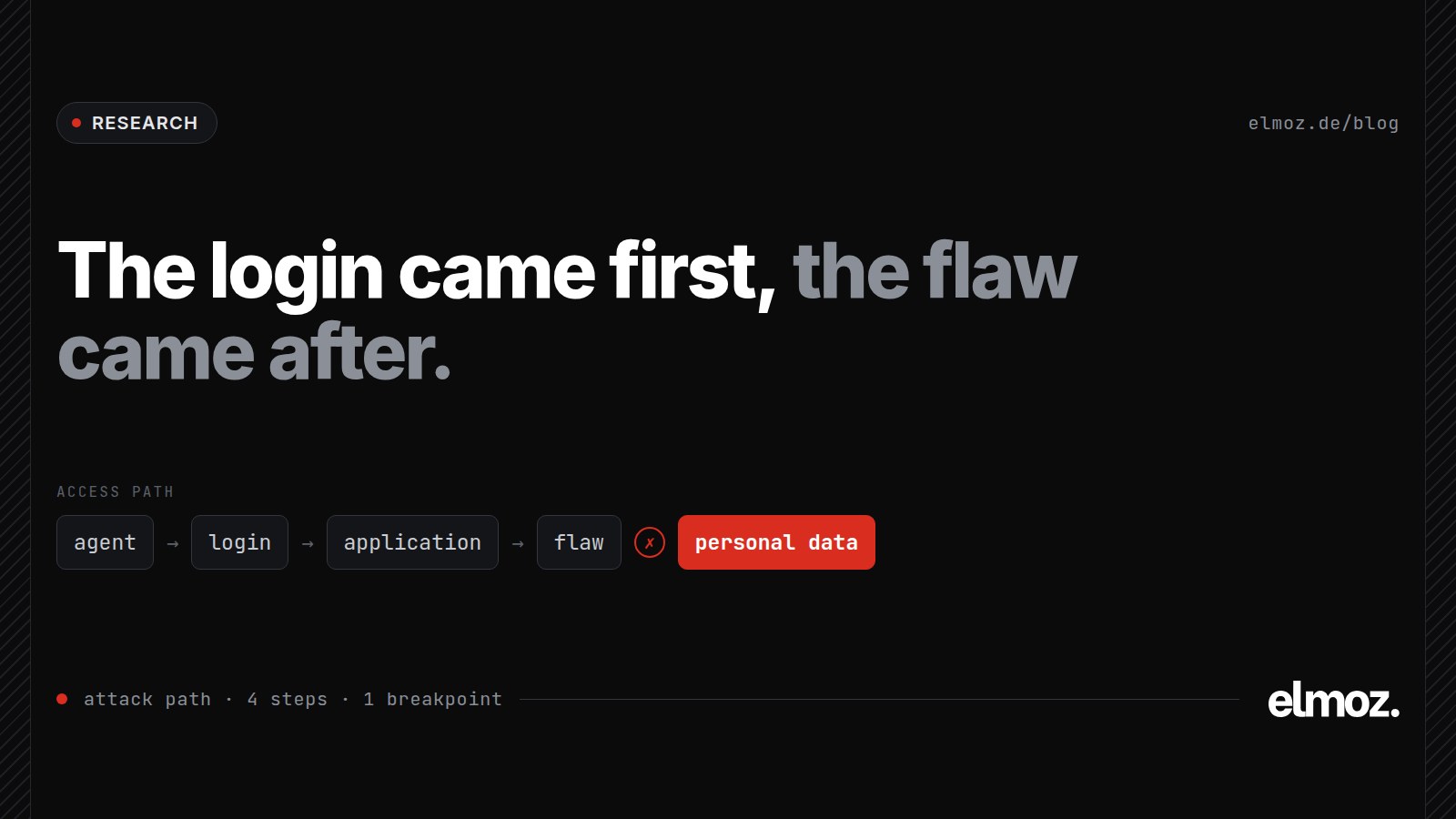
On 14 September 2026 the Spanish data protection authority published a short note about a breach notification it had received. A controller reported that the attacker had been an autonomous AI agent. It is, as far as the regulator is aware, the first such notification it has logged. The interesting part is not that an agent did it. It is the order of the steps the AEPD describes.
The agent logged in first. It found the vulnerability afterwards.
TL;DR
- Per the AEPD, the agent searched generic files for weaknesses and completed a successful login. Only then, already inside, did it start looking for flaws in the application.
- It found one, modified personal data and accessed invoices. The regulator names neither the organisation nor the volume of records.
- The AEPD's own framing is a credential argument: an agent that obtains an account, an API key or a token with excessive permissions can operate at machine speed.
- The agency is explicit that one notification is one notification. It states this does not establish a statistical trend.
#What the AEPD actually said
The note is short and the agency is careful with it. In its wording, the attacking agent began a search for vulnerabilities in generic files and completed a correct login. Once it had access to the system, it began autonomously searching for vulnerabilities in the application. Having found them, it was able to modify personal data and access invoices.
That is the whole technical account. The AEPD does not name the controller, does not quantify the affected records, and says the available information comes from the notification itself and still needs analysis. Its deputy director Francisco Pérez Bes, quoted by Help Net Security, put the caveat plainly: a first notification does not let anyone establish a trend, but it is a sign that AI-supported attacks have stopped being a theoretical risk and are starting to show up in incidents that affect real processing of personal data.
Treat the detail accordingly. This is a regulator summarising one victim's own report, not a forensic write-up. What makes it worth reading anyway is that a supervisory authority has now written the sequence down.
#The order of the steps is the finding
Read the sequence again and notice where the boundary was crossed. The login succeeded before any application flaw was discovered. The vulnerability was not the way in. It was what the agent did once it was already authenticated.
The AEPD does not say how the login succeeded, and neither will this post. It could have been a weak password, a reused credential, a valid service account, an exposed key. What the report does establish is the shape: authentication first, exploitation second, data manipulation third.
That shape inverts the usual patching conversation. Most vulnerability management assumes the flaw is the entry point, so the fix is the patch. Here the flaw only decided what an already authenticated session could do. If the account had been scoped to what it actually needed, the same flaw would have produced a much smaller incident, or none at all.
An agent that obtains an account, an API key or a token with excessive permissions can operate at machine speed.
That sentence is the AEPD's, not a vendor's. A data protection regulator has just described the problem as a permissions problem.
#Anatomy of the path
agent              # autonomous, per the controller's notification
  → successful-login   # method not disclosed by the AEPD
  → application        # autonomous search for flaws, from inside
  → flaw-found         # exploited post-authentication
  → personal-data      # records modified, invoices accessed
Only one step in that chain is a vulnerability. The other four are identity and access questions: who held the account, what it was allowed to reach, whether anyone would notice it behaving at machine speed, and what it could change rather than merely read.
The write permission deserves its own line. The agent did not only read personal data, it modified it. Read access produces a confidentiality breach. Write access produces an integrity breach, and integrity breaches are far harder to unwind, because restoring them means knowing exactly which records changed and when.
#Why a regulator writing it down matters
Under Article 33 GDPR a controller has 72 hours to notify a personal data breach. That clock does not care whether the actor was a person or a process. What changes with an agent is the evidence you need in order to answer the regulator's next questions: which records were affected, when, and by which identity.
If the acting identity is a service account shared by several jobs, with no owner and no session-level logging, those questions do not have answers. That is not a novel failure. It is the ordinary state of most machine identities, and this case is the first time a supervisory authority has had to read a breach report written from inside it. We looked at the reporting thresholds for the NIS2 side of this in an earlier guide to reporting AI agent incidents; the evidence problem is the same on both tracks.
The AEPD's own conclusion points the same way. It argues that manual intervention is no longer sufficient, that organisations need fast detection, containment and response, and that digital identity and credential security need strengthening. Read as a regulatory signal rather than as advice, that tells you which questions a supervisory authority is likely to ask after the next one of these.
#What to check this week
- List the accounts that can write, not just read, personal data. Start there rather than with the full inventory. Modification is the part that turns a bad week into a reconstruction project.
- Check which of those accounts are non-human. Service accounts, integration users, API keys, agent identities. For each one, name the human who owns it. Every blank is a finding.
- Confirm you could answer the 72-hour questions. For one such identity, try to produce a list of the records it touched last Tuesday. If you cannot, your logging gap is a notification gap.
- Rate-limit at the identity level. A human session and an agent session look different in requests per minute long before they look different in content. That threshold is the cheapest machine-speed detection you will build.
- Separate read from write in your roles. Most integration accounts were granted write because it was simpler on day one. Split them and see what actually breaks in staging.
- Review authentication for service accounts specifically. MFA, credential age, whether the same secret is in more than one place. The AEPD note begins with a successful login, and that step is the one you control.
- Write down who declares an agent incident. The 72 hours start at awareness. Decide now who is allowed to start that clock, so nobody spends a day deciding whether a machine actor counts.
One notification is not a trend, and the AEPD says so itself. What it is, is the first time the sequence has been written down by a regulator, and the sequence puts the credential before the exploit. Elmoz maps which of your non-human identities can reach personal data, and which of them can change it.